Showing posts sorted by relevance for query simon johnson. Sort by date Show all posts

Friday, September 26, 2008

Free Theatre for 4 more performances

9/26/08 Catch This if You Can

Last night we saw the first performance of Profile Theatre's new season, "I Ought to be in Pictures." Each year Profile features the works of one playwright. This year it's Neil Simon. There are 4 more performances of this FREE staged reading: the next three nights at 7:30 PM and tomorrow afternoon at 2:00 PM. All performances are held at Theater! Theatre!, 3430 SE Belmont Street, Portland, OR 97214.


Danny Bruno and Kelly Marchant in "I Ought to be in Pictures."


This is a fully staged reading directed by veteran director and actor JoAnne Johnson.

This season Profile is also offering five free One Night Stands, audience builder performances.

Profile Theatre picks a "monster" for its 2008-'09 season

by Marty Hughley, The Oregonian

Tuesday May 20, 2008, 2:40 PM

"Is nothing sacred? Are there no secrets to be kept? But the Monster has observed, and what he has observed, he will reveal. Even the truth about himself."

The monster in question? Would you believe that master of mainstream comedy, Neil Simon?

Most folks would consider Simon a monster only in terms of professional stature, as a Tony- and Oscar-gobbling titan of the typewriter, the creator of such beloved popular entertainments as "The Odd Couple," the only playwright to have had four Broadway shows running simultaneously. But that quote is his own, from the intro to the 1971 book "The Comedy of Neil Simon." And it is both his commercial potency and his gifts as a trenchant observer of human foibles that make him a natural choice as the focus for Profile Theatre's 2008-'09 season.

The company's 12th season -- each of which has been devoted to the work of a single playwright -- will include four full productions and two staged readings of Simon's works, plus a reading from the yet-to-be-determined playwright for 2009-'10:
"I Ought to be in Pictures" (reading), Sept. 25-28
"Fools," Oct. 15-Nov. 16
"Lost in Yonkers" (reading), Nov. 20-23
"Biloxi Blues," Jan. 14-Feb. 15
"Jake's Women," Mar. 4-April 5
"The Sunshine Boys," May 13-June 14
2009-'10 sneak preview, June 18-21.


Tickets go on sale July 1; www.profiletheatre.org or 503-242-0080.

Tuesday, November 4, 2008

Financial Crisis & Recession

In case you're wondering about the roots of the current financial crisis, here's a summary by Professor Simon Johnson from his testimony before the Joint Economic Committee of Congress on October 30, 2008.


"In the United States, we have been aware of an impending economic slowdown for over a year. We will never know how pronounced the slowdown would have been in the absence of the acute credit crisis that began in mid-September. That crisis has triggered an ever-expanding series of impacts on the global economy that have almost certainly plunged our economy into a serious recession. The constriction in the availability of credit itself has a real impact on spending and investment by consumers and businesses. The widespread fear generated by events over the past six weeks has had an additional chilling effect on consumer and business confidence. The financial crisis has triggered severe economic problems in emerging markets, which have spilled back into the economies of some of our most important trading partners. Some prominent economists are raising warnings that de-leveraging in the "shadow banking system," such as by hedge funds, could trigger another wave of asset price falls across global markets.

"I am not saying that the sky is falling on the US economy. As of now, most forecasts indicate that we will experience a serious recession, perhaps comparable to the recession of the early 1980s, but nothing like the Great Depression. However, I want to underline the point that most of the most pedigreed economists and policy makers have failed to anticipate the serial effects that the crisis has had, and that it may yet have more surprises for us."

Professor Johnson goes on to give his views on the need for an economic stimulus. A breakdown of the summary can be found in his testimony.

Click here for a link to another of his articles: Recession for Beginners.


Sunday, November 2, 2008

To Buy or Not to Buy

To Buy or Not to Buy

From Baseline Scenario

By Peter Boone, Simon Johnson, and James Kwak, copyright of the authors

Judging by the traffic on the Planet Money blog, many people are wondering if now is the time to be spending money. On the one hand, we hear that the economy is crashing because of a decline in consumer spending. On the other hand, we hear that the economy is crashing, which frightens us to consuming less and saving more for the rainy days ahead. Real economists worry about these things, too - see Paul Krugman and Tyler Cowen, for example. But at the end of the day, all economists can do is speculate and watch what happens, because aggregate consumption is just the sum of hundreds of millions of individuals making their own purchasing decisions.


I’m not a personal financial advisor, but I think this can be broken down logically. Let’s assume that, before the current downturn, you chose with your level of spending (and, by implication, your level of saving) rationally. Then there are three main reasons why you might want to reduce spending today:

(1) you don’t have the purchasing power you need to maintain your spending

(2) you are going to lose your job (I know there’s a problem with that statement, and I’ll come back to it)

(3) the assets you are counting on for retirement have fallen enough that you need to increase savings in order to replenish them.


(1) applies if, for example, you were going to remodel your kitchen but you can’t tap your home equity line anymore because you have less equity than you used to, or your bank has cut your credit card limit below the level you need to maintain your spending. In these cases, you have no choice. If, however, your bank just reduced your credit card limit from $20,000 to $10,000, but you never use more than $5,000 of the limit anyway, then this doesn’t affect you.

(3) applies if you are relatively close to retirement and you didn’t have a big cushion to begin with. If you were just barely on track to meet your retirement savings objectives, and now your 401(k) has lost 40% of its value along with the stock market, then you may have to boost your savings rate. However, if you are in your 20s (or your 30s, if you spent an inordinate amount of time in school), you probably don’t have enough assets to have suffered much losses. What you care about (roughly speaking) is the value of the global stock market when you retire in 2045, which depends on the state of the global economy in 2045, which, one can argue, is pretty much unaffected by whatever happens now. In fact, the fall in asset values may be good for you, because most of your wealth accumulation is ahead of you, meaning you will be able to buy the same assets more cheaply than you could have a year ago. (If you are one of the many people who never earned enough to accumulate much for retirement - and I know this is a huge problem in our society - and are therefore relying on Social Security, then (3) doesn’t affect you either.)

(2) applies if you are going to lose your job. But even in a deep recession, not that many people lose their jobs. The forecasts I see are roughly that unemployment will rise from about 6% now to about 8.5% in a bad recession - could be better, could be worse. That means that 2.5% more people will be unemployed than are unemployed now, or 1 in 40 people. (This is a simplification, because more than 1 in 40 people will be laid off, but some people currently unemployed will get jobs, and some people will get laid off more than once, and so on.) The problem is that most people don’t know if they will be laid off or not. If you think there is a decent chance that you will get laid off, and that you will have trouble finding a job afterward, then it makes sense to increase your savings to protect against that possibility. But if you are sure that you won’t be laid off, or sure that you could find another job relatively easily, then (2) doesn’t affect you.

(1), (2), and (3) collectively will apply to a fair number of people. But if you are young, are secure in your job and your employment prospects, and still have enough credit to buy what you want to buy, then I don’t see why a recession should cause you to change your habits significantly.

In any case, you shouldn’t buy or not buy because of what you think the US economy needs. It’s not your responsibility. If collective thrift by the American people threatens to plunge us further into recession, then it’s the government’s job to compensate by increasing spending, as Krugman argues (and as we’ve been repeating on this blog). So do what you need to do for yourself and your family.

Wednesday, November 12, 2008

More on the G-20

More on the G-20

Eight Isn't Enough: G-20 Countries To Meet In D.C.


by Michele Kelemen


Morning Edition, November 12, 2008
·

To listen Click Here and then click on Listen Now.

Sometimes it takes a crisis to make big powers realize that their diplomatic clubs shouldn't be so exclusive. So instead of gathering leaders from the Group of Eight to talk about the financial crisis, the Group of 20 is converging on Washington, D.C, this week.


Formed in 1999 as a response to the financial crises of that decade, the G-20 is a forum for emerging economies and the world's richest nations to talk about global economic stability. Usually, G-20 finance ministers and central bankers gather. The Nov. 15 meeting will be the first head of state G-20 summit.


The G-20 is comprised of 20 of the world's largest economies: Argentina, Australia, Brazil, Canada, China, France, Germany, India, Indonesia, Italy, Japan, Mexico, Russia, Saudi Arabia, South Africa, South Korea, Turkey, the United Kingdom, the United States and the European Union.


The Bush administration has been playing down expectations for the summit. But Eswar Prasad of the Brookings Institution says the forum needs to address calls to reform the World Bank and the International Monetary Fund to "give the large emerging market economies the seat at the table they deserve and the level of influence they deserve."

When it comes to reforming the international financial institutions, the Americans and Europeans always seem to get "cold feet," says Raghuram G. Rajan, a former chief economist at the IMF. He says there is "a certain amount of plausible deniability in this meeting" because this is a transition time in Washington. The Bush administration can just listen and not have to make decisions.


Rajan, who is a professor of finance at the University of Chicago Booth School of Business, says that "if enough of the other countries make their voices heard at this meeting and say we are not willing to go along with incremental change, it does put a lot of pressure on the Obama administration to respond, because this is a crisis that was made in America."


President-elect Barack Obama's administration also will have to think about what sort of diplomatic grouping would be most appropriate to deal not only with this financial crisis, but also other global challenges — from climate change to nonproliferation.


Most experts believe that China and India have to be invited to dinner — not just dessert — at G-8 summits. Zbigniew Brzezinski, who was national security adviser under President Jimmy Carter, says the G-8 should expand to a G-14 or G-16.


"I think participation should be determined by some generalized definition of international influence, which means, yes, economy, money, but also military power and willingness to act on the global scene as a sort of responsible shareholder," Brzezinski says.


Brent Scowcroft, who was national security adviser for President George H.W. Bush, says, "There is no magic number." If you make the group too large, he says, it becomes unwieldy, and if it remains small, you leave out important players.

Related Story.
G-20 To Work On Reviving Economic Downturn

Morning Edition, November 12, 2008 · Leaders of the world's 20 largest industrial nations and emerging economies meet this week in Washington, D.C., to discuss the global economic downturn. Simon Johnson, a professor at MIT and a former IMF chief economist, tells Ari Shapiro that the meeting could be a springboard for a more fundamental restructuring of the international financial system.


Saturday, July 4, 2009

How to buy friends and alienate people

clipped from baselinescenario.com

The Baseline Scenario


How to buy friends and alienate people


The banking industry is exceeding all expectations. The biggest players are raking in profits and planning much higher compensation so far this year, on the back of increased market share (wouldn't you like two of your major competitors to go out of business?). And banks in general are managing to project widely a completely negative attitude towards all attempts to protect consumers.


This is a dangerous combination for the industry, yet it is not being handled well. Just look at the current strategy of the American Bankers' Association.


Edward L. Yingling is justifiably proud of his organization's postion as one of the country's most powerful lobbies.


His testimony to Congress on the potential new Consumer Financial Protection Agency plainly shows where his group stands. The most revealing quote, highlighted in the ABA's own press release, reads:


"It is now widely understood that the current economic situation originated primarily in the largely unregulated non-bank sector," he said. "Banks watched as mortgage brokers and others made loans to consumers that a good banker just would not make and they now face the prospect of another burdensome layer of regulation aimed primarily at their less-regulated or unregulated competitors. It is simply unfair to inflict another burden on these banks that had nothing to do with the problems that were created."


The premise here is false. If major banks had really not been involved in the mortgage fiasco, we would not have had to roughly double our national debt-to-GDP in order to save the US and world economy.


Within the banking community, and presumably within the ABA's membership, there is serious tension. The small banks feel – overall with some justification – that the essence of the recent problem was not about them. But they can't bring themselves to suggest publicly that the economic and political power of the largest banks should be curtailed.


Small banks have always had clout in the American political system, particularly when they work through the Senate. But we have not always had our current kind of crisis. The executives of these banks lived comfortably in the 1950s and 1960s; their kind of banking was boring, stable, and nicely remunerated.


It is the changing nature and power of the largest financial institutions – banks of various kinds – that has damaged our system since the 1980s; the rise in financial services compensation is part symptom and part pathogen. Big banks present the major risk going forward – to both the economy in general and to smaller banks in particular.


Most banks are "small enough to fail" (seven closed yesterday). It is absolutely not in their interest to have some banks that are perceived to be "too big to fail" and to ever re-run any version of the last two years.


The ABA should be discussing and addressing this issue. Instead, it is making all banks unpopular by opposing sensible legislation aimed at protecting consumers – look at the public relations context provided, for example, by Citi's recent move on credit cards.


The ABA's leadership needs to quickly rethink its approach.


By Simon Johnson

Saturday, October 10, 2009

The power of access

clipped from finance.yahoo.com
ap

Wall Street speed dial gets Tim Geithner directly

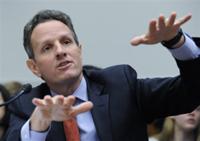
Wall Street cadre has Geithner on speed dial: When these men call, Treasury boss answers

  • On 4:26 pm EDT, Thursday October 8, 2009


WASHINGTON (AP) -- As the federal government propped up the housing market and braced for the collapse of General Motors this spring, Treasury Secretary Timothy Geithner capped a busy week with phone conversations with three men.

The first was Lloyd Blankfein, the CEO at Goldman Sachs Group Inc.


The second was Jamie Dimon, the CEO at JPMorgan Chase & Co.


The third was President Barack Obama.


Dimon and Blankfein are members of an exclusive club: Along with executives at Citigroup Inc., they are among a cadre of Wall Street executives who have known Geithner for years, whose multibillion-dollar companies survived the economic crisis with his help, and who can pick up the phone and reach the nation's most powerful economic official.


Geithner's calendars, obtained by The Associated Press under the Freedom of Information Act, offer a behind-the-scenes glimpse at the extraordinary influence of three companies. More than any other company or any of their rival banks, Goldman, Citi and JPMorgan can get Geithner on the phone several times a day if necessary, giving them an unmatched opportunity to influence policy.


"They're people he has relationships with and who he can trust," said Taylor Griffin, a Treasury Department spokesman during the George W. Bush administration and an adviser to the 2008 presidential campaign of John McCain. Griffin defended Geithner's relationships with industry executives. "There's only so much time in the day and you can only talk to so many people. You choose the people whose point of view you value."


There is nothing inherently wrong with senior Treasury Department officials talking to industry executives, or even with the secretary keeping tabs on the market's biggest players. But the calendars offered fodder for critics who say Geithner is too close to the Wall Street firms he helped bail out following the economic meltdown.


"It's appropriate for Treasury officials to keep in touch with those who work in the markets every day, particularly when the economy and the markets are so fragile," Treasury spokesman Andrew Williams said.


Not all players in the market enjoy the same access. In the first seven months of Geithner's tenure, his calendars reflect at least 80 contacts with Blankfein, Dimon, Citigroup Chairman Richard Parsons or Citigroup CEO Vikram Pandit.


Geithner had more contacts with Citigroup than with Rep. Barney Frank, D-Mass., who leads the effort to approve Geithner's overhaul of the financial system. Geithner's contacts with Blankfein alone outnumber his contacts with Sen. Chris Dodd, D-Conn., chairman of the Senate Banking Committee.


Partly this is explained by the extraordinary clout of these companies. Goldman, JPMorgan and Citigroup are among the dominant Wall Street players. Their executives can move not just markets but entire economies. Treasury invested heavily in all of them to keep the industry afloat, and Citi faces tighter scrutiny because Treasury owns a larger stake in the bank.


But size does not tell the whole story. Treasury has a huge financial stake in North Carolina-based Bank of America Corp., but CEO Ken Lewis appears on Geithner's calendars only three times. Morgan Stanley CEO John Mack also appears three times.


Smaller banks have felt frozen out of the process as the Treasury Department, first under President George W. Bush and now under President Obama, pushed through massive financial plans, said Wayne Abernathy, a lobbyist with the American Bankers Association, which represents banks of all sizes.


"Their focus was the big banks," he said. "They only focused on the guys that occupied the biggest space in front of them. We constantly remind them that there are hundreds of other banks, and they've had to adjust their programs to take other guys into account."


Geithner's relationship with Goldman, JPMorgan and Citigroup dates to his tenure as president of the Federal Reserve Bank of New York, where he helped put together multibillion-dollar taxpayer bailouts for Wall Street last fall. Critics said the government was unwilling to let banks suffer the consequences of their bad bets.


When he arrived in Treasury's corner office, Geithner brought those relationships with him.


The prominence of those relationships is clear by the company they keep on Geithner's calendars.


On March 24, just after Geithner announced plans to help banks sell off toxic debts left over from the housing market meltdown -- which stood to be a boon for big banks -- his calendars reflect a busy morning. He had a briefing on terrorism financing, a meeting on tightening financial regulations and a prep session for congressional testimony.


Geithner emerged to take just three phone calls, from Vice President Joe Biden, New York Attorney General Andrew Cuomo and, shortly before heading to Capitol Hill, from Dimon.


Officials at JPMorgan, Citigroup and Goldman had no comment on Geithner's calendars. Geithner did not take questions during his only public appearance Thursday, a conference call with reporters. Asked about Geithner's contacts with Wall Street, White House spokesman Robert Gibbs said the administration had "tremendous confidence in his stewardship and in his leadership."


Geithner's predecessor at Treasury, Henry Paulson, similarly kept in close touch with Wall Street power brokers. In particular, he was criticized for his close ties to Goldman, his former employer.


But Geithner's calendars show Geithner is too close to Wall Street, said Simon Johnson, a former chief economist with the International Monetary Fund and professor at the Massachusetts Institute of Technology's Sloan School of Management.


"Your worldview in the middle of a crisis depends on whom you talk to and what their perspective is, and you need a broad cross-section of opinions to truly understand what's happening," Johnson said.


By seeking information from such a narrow group of contacts, Johnson said, Geithner risks limiting his exposure to the views of his trusted banker colleagues.


Geithner must believe he can set aside their inherent biases, he said, adding, "I don't see how you do that."


clipped from baselinescenario.com


Yesterday Simon pointed out the AP story highlighting Tim Geithner's many contacts with a few key Wall Street executives — primarily Jamie Dimon, Lloyd Blankfein, Vikram Pandit, and Richard Parsons — while leading the government's rescue efforts as Treasury secretary. It's certainly useful for the nation's top economic official to talk to people in the banking industry, and it's also useful for him to talk to banks that are being bailed out by the government. But the AP story did come up with a few important distinctions. Geithner talked to these Wall Street executives more than the key people in Congress — Barney Frank and Christopher Dodd — that he needs to pass his regulatory reform plan. And he talked to them much more than to, say, Bank of America, which is equally big and equally in debt to the government. So to be clear, Geithner is talking to these people more than dictated by the requirements of his job (or he's not talking to Ken Lewis enough).


Still, you could say, what's wrong with that? Can't Tim Geithner talk to whomever he wants to talk to?


Of course he can, in a legal sense, and no one is saying he is doing anything illegal. All the evidence is that Geithner is a man of unassailable integrity, and a modest, courteous guy to boot.


But as the lobbyists have known for decades, the key to political power in the United States is access. Under-the-table bribes are relatively rare. The revolving door (government officials taking lucrative jobs at the companies they used to oversee) is important, but of little use when it comes to the very top people. Paul O'Neill, John Snow, and Henry Paulson were already easily rich enough to overlook such temptations (although Snow did leave Treasury to become chairman of Cerberus); Geithner may not be a mega-millionaire, but he already turned down his shot at being CEO of Citigroup in 2007.


Instead, if you want to sway some of the top people in government, the most important thing is to talk to them. All of us are influenced by the information and opinions that we are exposed to. Many people have a tendency to agree with either the first person or the the last person they spoke to on a particular issue, regardless of what other information they take in. (Where Geithner falls on that spectrum I have no idea.) This is why lobbyists make so much money; they sell access.


If, in the midst of a financial crisis, you get a disproportionate share of your advice from a few select Wall Street veterans with enormous personal interests in your decisions, you will be swayed a certain way. This is particularly worrying if you have spent the last several years even more deeply steeped in that circle, because you will be getting information and ideas that are confirming your prior beliefs. It is also worrying if, as was the case this past year, you do not have the time for detailed fact-finding or empirical studies, and instead you have to make important decisions based purely on logic and conjecture. Instead, you (and the public) would be better served going out of your way to talk to people who do not share your prior perspective and are likely to disagree with you. Now, the Obama administration is nowhere near as bad as the Bush administration, which disdained talking to its critics; this administration has reached out to its intellectual opponents, for example in the famous White House dinner with Krugman and Stiglitz. But one dinner does not balance eighty phone calls.


There's nothing scandalous about the fact that Tim Geithner talks to the CEOs of Goldman, JPMorgan, and Citi a lot. It's just a fact. It's a fact that demonstrates the deep linkages between the thinking inside Treasury and the thinking on Wall Street (and yes, I know Citi and JPMorgan are in Midtown). It's also one reason I have little interest in conspiracy theories — who needs a conspiracy when you have a sympathetic ear in the Treasury Department that you can get access to regularly? As we've said before, the key factor throughout this financial crisis has been political power. And if that power is composed of the power of ideas and the power of relationships, so much the better.


By James Kwak